
Rev. Jim Ryan, Ph.D.
I am a son of Paul of the Cross, outside the mold perhaps, but a son nonetheless. From the age of 11 to 18 the influence of other sons of the Founder of the Passionists acted as beams of light into the formation of my teenage years when I attended annual Seminary Weeks at Mother of Good Counsel Preparatory Seminary, Warrenton, Missouri. The first Sem Week I attended was in the summer of 1957 after 5th grade; the last in 1964 the year before I entered the Novitiate. Fr. Matt Sullivan told me that if I came to another Sem Week after 1964 he was going to put me to work by running it. In 1966 I attended that summer’s Sem Week as a professed member of the Passionists
For the first twenty years of my adult life being committed to the spiritual and monastic guidance of Paul Daneo and his heirs defined life for me. And then I, as others also did, transitioned to diverse life paths and practiced varying expressions of faith.
Recently, Jean and I joined with other heirs of Passionist life for a reunion in Louisville, Kentucky. We shared stories, songs, prayer, memories, news, meals, and opportunities to fund Passionist ministries. The invitation to attend and rekindle this formative past is a sign of an open and shared heritage with the man and saint whose charismatic life and mission lives to this day with a global reach.
Upon our return to Wisconsin I looked at the October calendar and was reminded that the Feast Day of St. Paul of the Cross came up on the 20th, The instruction and formation that was passed on to me about the life and ministry of Paul often returns to my mind and spirit. He fashioned a communal lifestyle of a mix of contemplation and action; monastic prayer and silence filled each Retreat and Convent in which his spiritual sons and daughters lived. Seasonal fasts revealed how food itself – particularly in reduction – can serve to fill up strength in the soul. Any action to be done was to be devoted to the work of preaching, hearing confessions, celebrating the church’s rituals and spiritual direction. We young monks lived this Passionist way. Among Paul’s first decisions as founder was to name this community The Poor of Jesus. He aimed those first years at the poor, the most neglected and deprived of instruction and growth in faith. History, church leaders and canonical regulations made adjustments and compromises to those first plans. In the meantime the young community responded to the call to expand its reach to the marginalized, the deprived and the neglected.
When Paul became good friends with Giovanni Ganganelli a certain fate was sealed. This friend grew an attachment to the black-robed itinerant who wore the sign of the Passion over his heart and whose preference was to roam barefooted across the Papal States as he called others to embrace the salvific power of the passion, death and resurrection of Jesus. The future Pope Clement XIV (none other than Ganganelli himself) gave final and full approval on September 3, 1770 to the Rule which Paul had first written in 6 days early in December, 1720.
Clement sealed the deal by giving the Basilica of Sts. John and Paul, atop the Caelean hill in Rome with its accompanying monastic residence to serve as the headquarters of the Passionists. He also gave the community permanent possession of the Retreat on Monte Argentario dedicated to the Presentation of Our Lady in the Temple. Paul himself had a deep fondness for the hill top retreat across the causeway from Orbetello. In 1728 on a trip to Rome, he asked to stay awhile in an abandoned hermitage on the mountain island, and always remembered the spiritual blessings received at that invigorating location.
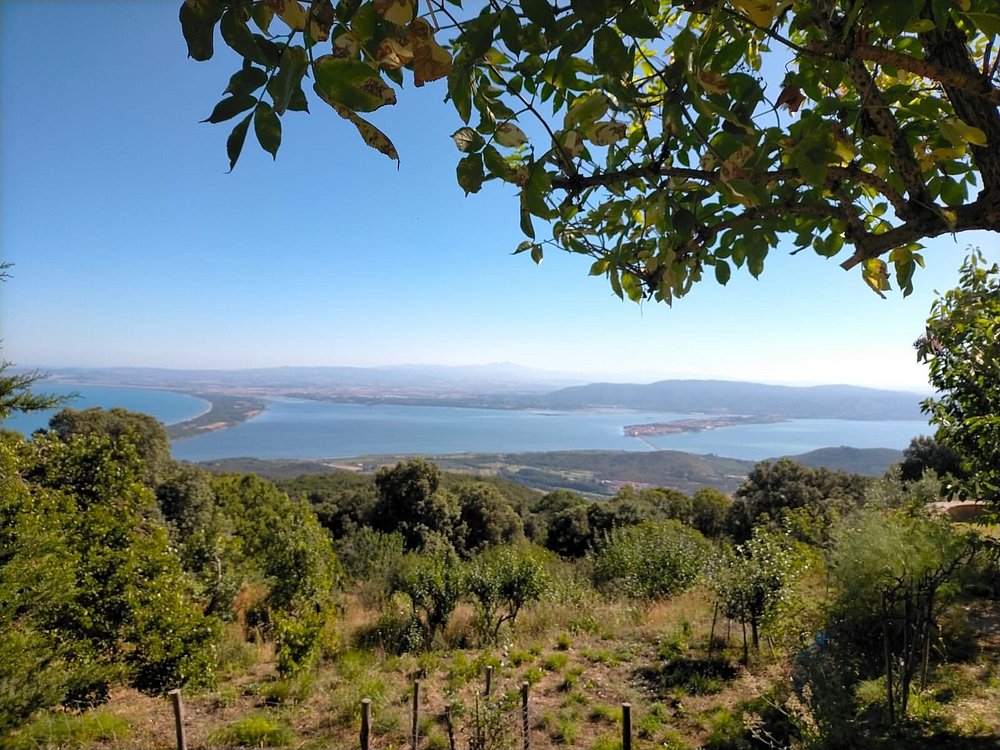
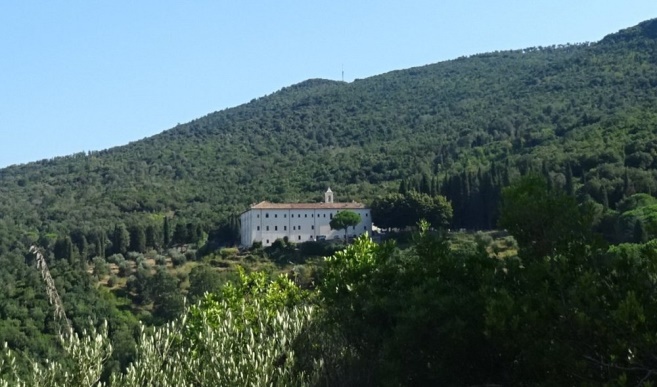
Retreat of the Presentation & View from Monte Argentario
In recalling this history Paul Daneo’s skills stand out. They include both his spiritual adeptness at proclaiming the Word and the ability to read those signs of his own times that quite literally enabled him to take care of the community’s business.
Here is where I give thanks that my own father purchased the English translation of the letters of St. Paul of the Cross. Following his death, the volumes became mine. Even greater thanks go to the translators and editors who made it possible for us to grow richer in knowledge of the founder’s life. They are Roger Mercurio, Frederick Sucher, Laurence Finn, and Donald Webber, members of Holy Cross Province. As noted at the beginning of this article I embrace a spiritual sonship but in no way am I a Paulacrucian scholar; nor am I deeply studied in Paul Daneo’s life and legacy. I am merely a reader; one whose appreciation of who Paul was has benefited by gaining a fuller picture of the man. Here are a couple examples of this broadened view.
First, and most importantly, the letters attest to the sincerity and depth of his own life’s journey which embraced the Cross and Passion of Jesus Christ. His call to preach and counsel was a divine gift that has enriched the Catholic Church in ways he did not likely foresee.
Second, I note in the letters that a fair number of Paul’s early companions were already ordained. I recall reading that in mid to late 18th century the Papal States had a large surplus of priests. Bishops ordained these men with little or no evidence of support for their living conditions. Apparently, they lived on income from Mass stipends and whatever alms came their way with little assistance from the dioceses to which they were attached. To call their living conditions apartments which were constructed behind the churches where they offered their Masses would be an affront against what we understand to be an apartment. Not much more than huts, this is where they lived their solitary lives. The gift which Paul of the Cross offered these priests who joined the Poor of Jesus was the mutual support and care of community living. Once they professed vows following a rigorous Novitiate year they then shared in the spiritual and physical health that community makes possible.
Finally, for me this fuller picture of the man, Paul Daneo comes through in his ability at negotiating for the material needs of his religious family. I expect he learned such skills from his father, Luca, who sold dry-goods – not always successfully – in various places in and around Genoa. In the letters Paul appeals to wool merchants for a fair price (and even lower) so that the brethren could be clothed. Also, to the wine merchants he beseeches/begs for sufficient vats of wine for both sacramental and daily use (after all, this is Italy we’re talking about). In those times when wine could be safer to drink than water, such intercessions were a matter of safeguarding the health of the community.
Not that anyone asked, but in the viewpoint I offer here Paul of the Cross emerges beyond mystical insights and ascetical practices. This wider view of the man recognizes his charismatic personality as he connected with Popes, sinners, and all those in-between. I also find inspiration in his ability to respond to the signs of the times such as was shown by his skill at navigating life’s necessities and practicalities.
We sons and daughters of Paul Daneo walk many paths, but may we ever live as he did keeping alive the memory of Christ’s Passion in our hearts.