Rev. Jim Ryan, PhD — jimryan6885@gmail.com

Community blog: Apostolic Times, https://maryofmagdala-mke.org/
Homily thoughts – 3rd Sunday of Easter – April 19, 2026
The disciples who recognize Jesus as he breaks bread with them could have stayed in Emmaus, since that was apparently their destination. They already had so much to recount to the folks at home. Instead, they returned that same Sunday evening to Jerusalem to the Upper Room where they had shared the Passover meal with Jesus and his other followers three days prior; the meal at which the Teacher first broke bread, shared it, and said, “Do this in memory of me.”
At that Sunday evening meal one could imagine these two disciples were overwhelmed with the events of the previous days. And now this very knowledgeable fellow traveler is the one they recognize as Jesus alive! Their perception of who this person was changed in one simple act of sharing.
Let’s consider now the power of recognition. To recognize, or re-cognize, is an act of the mind and will responding to a revelation in the present as a new possibility. To recognize is not simply a matter of remembering, as in, “Oh yeah, I recognize you.” If that were the case the two disciples, having arrived at their destination, could say to Jesus, “Oh yeah, we remember you.”
Grandparents recognize in the eyes, or the smile, or the walk of their grandchild what they formerly saw in their own child who is now the parent of that grandchild. What’s new emerges from the old; the future from the former. A new revelation, to be sure; just as the Emmaus disciples recognized Jesus, when previously they just saw an enlightened companion on the journey. To recognize the Risen Jesus in this knowledgeable traveler is definitely something new for these disciples!
Let’s also consider that the gift of recognition is alive today in its power to reveal faith and truth. For example, those who wage war in Iran think they recognize their warring as carrying out a just war. It seems that they think by just using the words “just war” to identify the actions they agree with means they understand the actual meaning of just war theory. They are puffed up about this and are certain of their justification in executing their just war, to the extent that a few of them have taken to presuming to instruct Pope Leo on just war theory. It is laughable, as well as tragic, seeing mere politicians stumble through 1500 years of Catholic theology only to produce sound bites, bumper sticker phrases, and personal attacks.
An example of this theology actually being recognized comes to us by way of Pope Francis. His 2020 encyclical, “Fratelli tutti” contains a section titled, “War and the Death Penalty.” In it he writes on the injustice of war:
“We can no longer think of war as a solution, because its risks will probably
always be greater than its supposed benefits. In view of this, it is very difficult
nowadays to invoke the rational criteria elaborated in earlier centuries to speak
of the possibility of a “just war.” Never again, war!”
In a note accompanying this comment, Francis further offers:
“Saint Augustine, who forged a concept of ‘just war’ that we no longer
uphold in our own day, also said that ‘it is a higher glory still to stay war
itself with a word, than to slay men with the sword, and to procure or maintain
peace by peace, not by war.’”
Pope Leo has put it succinctly, “War is a failure of humanity.” One place, among many, where he proclaimed this was at a Prayer Vigil at the Colosseum in Rome in October. 2025. So, let’s not recognize the warmaking of this administration as anything close to a justification of Catholic moral and social theology.
Here’s a second recognition that should cause us alarm. It has to do with the Common Good. Patrick Deneen is a theologian (Notre Dame) favored by J.D. Vance. In his recent discovery of and commitment to Roman Catholicism, the Vice-President will no doubt take a lead from Deneen in recognizing the Common Good in American Society. In Deneen’s book, “Regime Change,” he favors a common good that is based more in choice than in well-being. Vance picked up on this when he attempted to apply a vision of the command to love God and neighbor through the lens of “ordo amoris.” Ordo Amoris (way/path of love), as taught by St. Thomas Aquinas, is intended to translate Jesus’ commands to love God and neighbor in a way that puts the commands into daily practice. One first loves God, then the neighbor, and then oneself. Vance says the order of loving one’s neighbor from most important to least important starts with family, then friends, then associates, then community members identified as those who belong, and then, maybe, immigrants. What Vance recognizes here is a watered down version of love for the immigrant and the stranger. By the time he got to that position he made it fairly easy for Pope Francis to remind him and the world that we, with a view to well-being, recognize Jesus in the immigrant and the stranger.
In short, the Common Good is not a matter of a power to choose what the good that is common should be. Rather, Common Good is a matter of well-being and not a condition based on choice.
The Dictionary of Catholic Social Thought presents 2 bases of the common good. First is forming social unity, and second is protecting human rights. And because it is a matter of justice, it is not a choice that we make when it is convenient or when all other life concerns are in balance. No, it is about recognizing over and over again the human responsibility for the well-being of society and all its members.
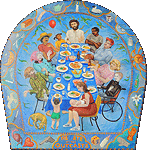
So, when Pope Leo says war is a failure of humanity, in Catholic theological terms he is saying we have failed and we must confess. This confession says we do not, and must not, glory in the use of weapons of war; this confession is not based upon individual sin, but based upon sinful social structures; and finally, this is a confession that war – despite what some might call victory – is always a failure. Not surprisingly, politicians who presume to lecture the Pope miss the point. The point is, to recognize well-being is to recognize Jesus, breaking bread with companion travelers for the common good of all humankind.
A Prayer (JR)
We humans, like Jesus, live in limited time on Earth. Like Jesus, we are called to use this time for the benefit of all and for the sustain-ability of Earth and all Creation. On this Easter Sunday we hear again the clear proclamation that death gives way to life, that the life we have been given never ends, and that we, like Jesus, are destined to be like God for we shall see God as God really is.
We pray in the name of the Savior, Risen in glory.
Amen, Alleluia!